军情解码
【新学期报到】仓前云帆幼儿园2024学年第二学期教职工开学报到暨元宵节活动_我的网站

A | 东风夜放花千树。
Editor's Note:
Ahead of the opening of the 2026 World AI Conference and High-Level Meeting on Global AI Governance, Chinese AI start-up Moonshot AI released its Kimi K3 large language model. As the world's largest open-source model by parameter count to date, this launch marks a significant step forward in the development of China's artificial intelligence models.
From the C919 airliner soaring into the skies to Unitree's humanoid robots stealing the show; from DeepSeek pushing the AI frontier to Moonshot AI's landmark unveiling of Kimi K3 - China's wave of homegrown innovations has dominated global headlines in recent years, delivering a steady stream of breakthroughs.
At a meeting in Beijing that brought together the national science and technology award conference, the general assemblies of the members of the Chinese Academy of Sciences (CAS) and the Chinese Academy of Engineering (CAE), and the 11th national congress of the China Association for Science and Technology in July, Chinese President Xi Jinping, also general secretary of the Communist Party of China (CPC) Central Committee and chairman of the Central Military Commission, stressed that the 15th Five-Year Plan period (2026-2030) is a critical phase for tackling tough challenges in building up the country's strength in science and technology.
"We must seize the historic opportunity, rise to the challenges of the times, accelerate efforts to achieve high-level self-reliance and strength in science and technology, and make steady progress toward the 2035 goal of becoming a leading country in science and technology," he said.
In the article "Strive for Greater Strength and Self-Reliance in Science and Technology" included in the fourth volume of Xi Jinping: The Governance of China, Xi pointed out, "Through years of endeavor, our country's overall strength in science and technology has improved substantially. We therefore have a solid foundation, and are fully confident in our ability to seize the opportunities offered by the new revolution in science, technology and industry to achieve greater results." The article also mentioned that "We should participate to the full in global science and technology governance, contribute Chinese wisdom, and shape a philosophy of technology for good purposes, so that science and technology better serve human wellbeing, and enable China's science and technology industry to contribute more to building a global community of shared future."
In the 27th installment of the special series "Decoding the Book Xi Jinping: The Governance of China," the Global Times, along with the People's Daily Overseas Edition, continues to invite Chinese and foreign scholars, translators of Xi's works, practitioners with firsthand experience, and international readers to focus on the theme of striving for greater strength and self-reliance in science and technology. Together, they share views on China's tech growth, governance principles, and global cooperation in science and technology.
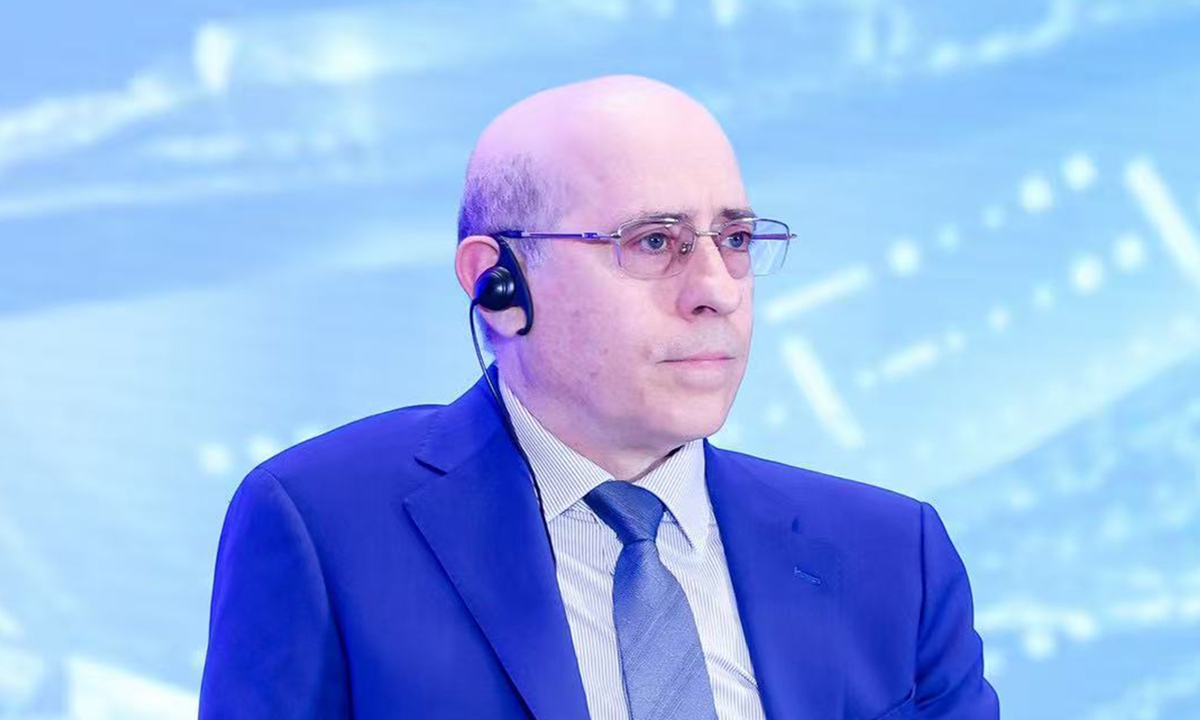
In the 27th article of the "Readers' Reflections" column, Global Times (GT) talked to Francesco Faiola (Faiola), an Italian professor at the Research Center for Eco-Environmental Sciences with Chinese Academy of Sciences and recipient of the Chinese Government Friendship Award.
GT: Chinese President Xi Jinping delivered a keynote speech at the opening ceremony of the 2026 World AI Conference and High-Level Meeting on Global AI Governance on July 17. He said that as a responsible major country, China is always committed to providing international public goods relating to AI. In the article "Boost Basic Research and Achieve Greater Strength and Self-Reliance in Science and Technology" included in the fifth volume of Xi Jinping: The Governance of China, Xi said, "It is important that we adopt a more open-minded approach to international exchange and cooperation in research to create an open, globally competitive innovation ecosystem." Amid the current complex global landscape, China remains firmly committed to keeping its doors open to international scientific collaboration. In your view, where does China's confidence in this commitment come from?
Faiola: I think China's confidence in staying open comes from a deep shift in mindset. The Chinese people, especially the scientific community, now really believe they are not inferior to Westerners. For a long time, even many people here thought top science had to happen at a Western address. When I first came, I believed that too. The US and Europe seemed like the only serious places for breakthroughs. Now that idea is changing, and moving toward China, because the evidence of leadership is everywhere: stem cell standards, artificial intelligence (AI) efficiency, green manufacturing. It's undeniable. China knows it has everything needed to attract and keep international talent. It's no longer a developing country playing catch up. It's a place that's helping set the global agenda.
That self-assurance is the bedrock of openness. When you truly believe you have unique strengths, like a huge organoid screening capability or a community of scientists who think deeply, you don't fear open doors. You want colleagues from everywhere to walk through so the science moves faster. My own lab works with European centers as equals. That parity is real. But we also know not everyone abroad gets this transformation yet. A lot of people still imagine Chinese science as just following others. That's exactly why China is pushing openness harder: funding lines for foreign principal investigators, open innovation hubs in Beijing, active participation in setting international standards. These aren't defensive moves. They're proof of a country confident enough to invite the world in, show what it can do, and create knowledge together.
On a deeper level, the confidence is also just rational. The big challenges - environmental problem, pandemic preparedness and precision medicine - are global. If China closed itself off, the data and validation its own regulators need would get weaker. So, the open door isn't charity. It's the smart recognition that scientific greatness today gets multiplied when you share it.
GT: In the article "Strive for Greater Strength and Self-Reliance in Science and Technology" included in the fourth volume of Xi Jinping: The Governance of China, Xi pointed out, "Through years of endeavor, our country's overall strength in science and technology has improved substantially. We therefore have a solid foundation, and are fully confident in our ability to seize the opportunities offered by the new revolution in science, technology and industry to achieve greater results." From the domestically built large passenger jet to DeepSeek, Unitree Robotics, and Moonshot AI's Kimi K3, China's innovation achievements have been making headlines. How do you assess China's achievements in sci-tech innovation in recent years?
Faiola: I measure China's innovation success in a very personal way. My parents are old, living in a small Italian town. They don't speak English. They don't understand molecular biology. They can't read a scientific paper. But over the past few years, they've called me up more than once, excited, telling me about a Chinese airplane or a humanoid robot or some AI breakthrough they saw on Italy's main TV news or in the newspapers.
That tells me something deep. These aren't niche stories for tech insiders. They are real global news, landing in the living rooms of retirees who barely use a smartphone. I'm not bragging to them about China's progress. They are telling me. When achievements get that far into everyday European life, it's a sign China is doing something the world finds worth talking about.
The C919 plane, DeepSeek, Unitree Robotics - these aren't one-off hits. They prove China can now conceive, design, and build complex, original systems on its own, whether it's an airliner, an advanced AI model, or an agile robot. That takes deep integration across different fields, aerodynamics, materials, real time control, and AI.
DeepSeek's whole philosophy, doing more with less, is exactly how we created affordable organoid screening tools. And the quiet shift from rule taker to rule maker in chemical safety standards, that mirrors the C919's ambition to compete globally on certification. All this shows China is blending manufacturing, digital smarts, and biology into one force. But my real proof is what I hear from my students. They don't just apply discoveries from papers anymore. They question the assumptions behind them. That intellectual confidence, and the fact it echoes all the way back to a small Italian town, is why I'm sure China will fully seize this moment.
GT: President Xi said that AI development should not be a solo performance by a single country, but a symphony of international cooperation. Having conducted research in China for many years, you are not only a witness but also a driving force behind China-Europe scientific exchanges. Looking ahead, how can both sides deepen complementary advantages and achieve mutually beneficial empowerment to jointly address global challenges such as climate change and health? Over the next five years, which specific sectors should China-Europe science and technology collaboration prioritize?
Faiola: I grew up in Italy and now I lead a lab in Beijing while working with colleagues all over Europe. So, China-Europe teamwork isn't some abstract idea to me. It's how my week actually looks. The old cliché, European basic research plus Chinese scale and speed, is already outdated. Both sides now generate novel insights. The relationship has to become genuine two-way cocreation.
I see three practical things that would deepen it. First, we need truly joint funding: one grant, one integrated team, maybe a Max Planck group and a Chinese Academy of Sciences group, with a single scientific plan and students who genuinely rotate between the labs. Second, we need to harmonize regulations and ethics for organoid technologies. Europe has advanced thinking on governance. China has manufacturing scale and the drive to get things into clinics. If we co-develop shared quality and ethical standards for organoid testing, we basically set the global benchmark. A liver organoid made in Europe could then be used directly for a toxicity screen in China without repeating all the validation. Third, we need deliberate talent circulation, not a zero-sum competition. Joint PhD programs where a student naturally moves between continents.
The science doesn't care about borders. If we build the shared tools now, China and Europe can show the world a model where shared knowledge beats division.
GT: Recently, some Western media and think tanks are peddling "China Shock 2.0," claiming that China is achieving fast development in high-tech sectors such as renewable energy and AI and relies on foreign markets to absorb its overcapacity, thus reducing the market share of developed countries and sending more serious shock waves to the global economy compared with the era of traditional manufacture industry. What's your comment on this? In your view, does this represent a new pretext for Western protectionism, or is it an unavoidable external misunderstanding amid China's industrial upgrading?
Faiola: I'm a bench scientist, not a political analyst. I stick to what I can see and measure in my own work. So, I'm not going to guess what the media or think tanks intend. I'll just tell you what the facts show me, and from my lab, the "China Shock 2.0" story just doesn't match up.
In my field of stem cell toxicology, the world is desperate for human relevant safety tests to replace animal testing. Tens of thousands of chemicals still don't have proper hazard data. When Chinese labs turn out high throughput organoid platforms at a fraction of the old cost, that's not dumping "overcapacity" into a full market. It's filling a huge shortage. A researcher in Brazil or Kenya suddenly gets access to a toxicity screen that never existed for them before. Demand is skyrocketing, not standing still. Meeting that demand is a service, not a shock.
With AI, it's the same pattern. DeepSeek's efficiency makes it cheaper and easier for biomedical researchers around the world to use these tools. It's helping create new markets, not stealing a fixed pie. Sure, any big shift causes some dislocation. The answer to that is domestic support and transition policies, not blocking technologies that help solve planetary problems.
。

B | 更吹落、星如雨。 宝马雕车香满路。

C | 凤箫声动,玉壶光转, 一夜鱼龙舞。 恭贺新禧 开工大吉 一年春作首,万事行为先 抖一抖精神,全新出发; 换一换新装,全新上岗; 整一整心情,全心投入。

D | 新年大吉,开工起航! 为确保新学期各项工作顺利开展,2025年2月12日上午,仓前云帆幼儿园全体教职工齐聚一堂,召开了2024学年第二学期教职工开学报到暨元宵节活动,本次会议为新学期工作锚定向,奏响了温暖而奋进的序曲。

E | 新年新气象,仓幼老师们已经提前布置好了温馨的返园环境,欢迎各位教职工的到来。 学期工作思路交流 Lantern Festival 新学期即将开始,蒋副园长向全体教职工送上了诚挚的新春问候,鼓励大家展望2025年。之后从加强师风规范管理、强化师训、职工活动、创家长满意学校、省一创建、工作月事历等方面进行了详细的布置,让全体教职工明确了新学期的工作思路和各项主要工作内容,鼓舞全体教师以饱满的热情迎接新学期的挑战。 师德师风开学第一课 德为师之本,师以德为先。为了进一步弘扬正气,加强师德师风建设,提升教师整体素质,蒋副园长为我们开展了幼儿园师德师风培训,希望每个老师都能带着职业的情感和操守与孩子们铭心相遇,保持初心,做美好教育的传播者。 安全重于泰山,警钟需长鸣,开学之际,诸副园长从工作目标出发,完善管理体系、落实安全教育、完善排查机制等方面进行部署与安排,以“五个不得”与全体教职工进行了细致地交流。 同时,诸副园长也提醒每位教职工要提高教师责任意识,增强安全防护能力,做到“早排查,早行动”,防患于未然,将安全工作落到实处。

F | “元”气满满 喜“宵”颜开 01.福气加倍 视差移动丨收缩动画 抽 福 气 啦 老师们脸上洋溢着幸福得笑容,将福气稳稳地收入囊中,为新学期的工作注入了满满的能量。 02.墨香凝福 以笔为媒,以墨传情。

G | 大家蘸墨挥毫,专注书写,将对新一年的美好祈愿倾注在每一个笔触之中。 左右滑动,查看更多 写福啦~ 小小的福字汇聚成大大的祝福 03.甜甜蜜蜜 自己动手更甜蜜~ 甜甜的的糖葫芦~ 04.喜乐满融 新学期第一张合照~ 左右滑动查看更多 冬去春来,辞旧迎新。

H | 新年染红了快乐时光,拉近了我们成长的距离,更对未来有了无限的期望。 开学,是一场崭新的遇见, 是梦想的再次启航。 期待在这充满希望的新学期, 与可爱的孩子们, 一同开启幼儿园生活的全新篇章! 元宵快乐, 记得吃汤圆哦~ 编辑|赵果举 初审|副园长室 终审|园长室。
Current article:http://c4vqz4y.zhuaicaisaanzhenshunnaiwei.bond/list_y6dtzmp/vjjf.html
Published on:16:56:15